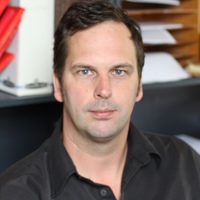
PD Dr. Stefan Schnell
Senior researcher and group leader (Corpus-based Typology group) at the Institute for the Interdisciplinary Study of Language Evolution, University of Zurich.
I am interested in the way that speakers of diverse spoken human languages verbalise events in connected discourse and how they keep track of the discourse referents across consecutive events.
I am specifically concerned with the cross-linguistic commonalities and differences in the interconnections between referential choice and sentence structure, and their impact on the diachronic development of grammatical structures.
I am a documentary and field linguist. I have been documenting and describing the Oceanic language Vera’a from North Vanuatu.
Latest publications
- Egurtzegi, A.,, Blasi, D., Sauppe, S., Bickel, B., Schnell, S. 2025. Discourse ergativity and human reference. Studies in Language (online). 10.1075/sl.23005.egu
- [outreach] Schnek, A., Schnell, S. 2025. Atlas der vom Aussterben bedrohten Sprachen. Köln: DuMont.
Corpus-based typology
Usage-based linguistics has for a long time sought to understand grammatical structures and their global distribution by making reference to regularities of language use. In doing so, it has often drawn on relatively confined and cross-linguistically skewed usage data.
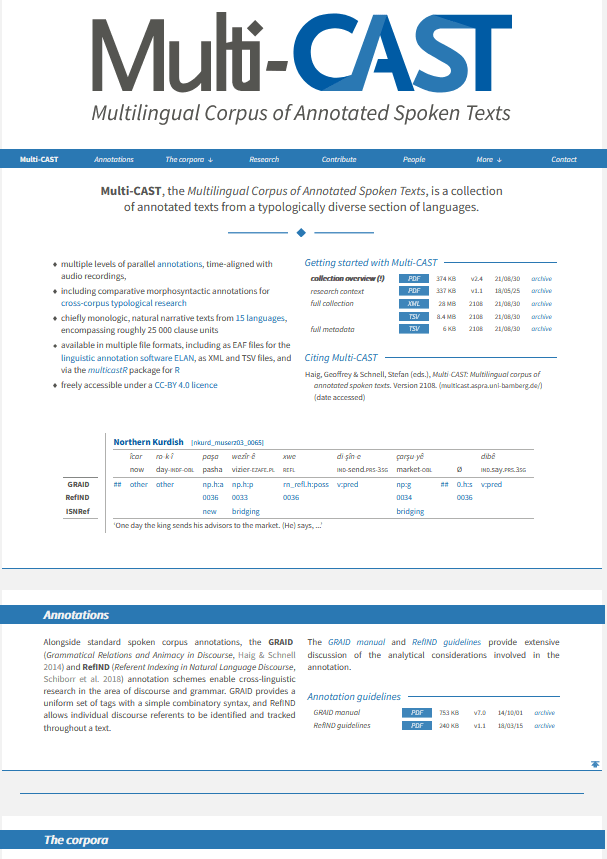
The multilingual corpus Multi-CAST, co-edited by Geoffrey Haig (Bamberg) and myself, its an attempt to improve on this situation, with its custom-tailored annotation schemes focussing on the interaction of reference production and event expression in spoken language discourse. Multi-CAST and the research based on it contributes in specific ways to the growing field of corpus-based typology.
Fieldwork and language documentation in North Vanuatu
I have been undertaking fieldwork on two Oceanic languages from Vanua Lava in North Vanuatu, Vera’a and the now extinct Lemerig. The documentary corpus of Vera’a consists not only of traditional and modern orature as well as stimulus-elicited texts, but also of texts documenting recent local history, ethnobiological knowledge as well as transcribed records of culturally significant events.

 Stefan Schnell